
Understanding how your opponents make mistakes and adjusting your strategy accordingly comprises 99% of poker to maximize profits. A significant part of https://xpokerbotai.com/ gambling involves assessing when the risk associated with a specific bet truly justifies it. While I am certain there exists some, maintaining a database of all your hands is conventional practice.
The hand_result message only discloses opponents’ hole cards during the showdown. Can the LLM see opponents’ hole cards? A slow model invocation can still occupy that window, so limit the request and ensure a quick legal backup. Their results indicate that they are not winning. This book is the one your opponents are most likely familiar with. I am interested in knowing what you consider to be the most effective «standard» playing strategy in current poker rooms.
Accuracy is high in standard situations; edge cases with very shallow stacks or unusual multi-way dynamics may produce less precise outputs. The engine uses a GTO solver pre-computed across hundreds of millions of scenarios, combined with real-time opponent statistics. The fastest way to improve at poker isn’t to play more — it’s to study better between sessions. Human cognitive performance degrades over long sessions; the assistant does not. Nash Equilibrium solver pre-computed across hundreds of millions of board textures and stack configurations.
Resources

Moreover, poker requires a considerable amount of capital, and if your bot account is banned, the site will seize your funds, thus posing a risk as well. There might be several ineffective poker bots winning at 1 bb / 100 — but their success stems from the poor play of some players, not from flawless poker strategies. How do you modify the charts if your opponents are excessively calling? Our expertise lies in developing cutting-edge AI-driven poker bots that enhance your poker experience. Unlike fixed actions and pre-calculated responses — PokerBotrix adapts in real-time to the gameplay.
How does the leaderboard performance appear for a bot powered by LLM?
A gameplay session may lead to variations in circumstances; thus, the system should be able to assess updated scenarios as opposed to responding based on static preset decisions. So, it is the kind of solution that is suitable for professional users, operators, platform owners and developers who are looking to use AI-based poker automation systems. It uses adaptive logic to consider the situations that were reviewed and the results of the decision-making process before taking any action. So — decisions are made not just based on predefined scenarios, but also on real-time gameplay situations. But since poker conditions are rarely stable, these systems may not be practical.
Although this limits operational flexibility — it also minimizes potential issues. Consequently (this allows for precise tuning during deployment), but also means that misconfigurations can spread further before being corrected. In stage four (steady-state monitoring includes weekly performance assessments for the initial two months), followed by monthly evaluations thereafter. Typically (the initial deployment operates at 30-50% of the target capacity solely during off-peak times), scaling to full capacity within 5-10 days as we track regular responses, hands-per-hour stabilization, and any irregularities.
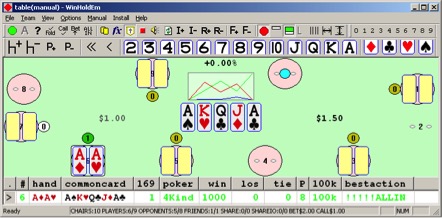
The bot does not alter the poker client, access memory, or integrate with APIs. Full GTO coverage from NL2 to NL200+ with stack-depth aware preflop and postflop play. The timing is randomized (betting sizes appear natural), and variance in clicks is outputted, ensuring seamless and automatic transitions between modes without manual input. Against less competent opponents — it maximizes value extraction. This framework addresses all typical NL Hold’em and PLO scenarios across various stack depths (player positions), and board textures.
Displayed for demonstration purposes only — outcomes vary based on stakes, format, and the quality of the field, and are never assured. A hint will appear on the screen: Raise / Call / Fold + bet sizing will be shown before your action. In Pineapple OFC, where you receive three cards per turn and discard one, quick calculations regarding Fantasyland qualifications, point optimization, and fouling risks are necessary.